Enterprise Quotation & Revenue Governance Platform
• Quotation workflows relied on spreadsheets, manual formulas, and inconsistent approvals. • Built a governed quotation platform with RBAC, deterministic calculations, and approval automation. • Reduced recalculation errors by 60-75% and accelerated approvals by 50%.
Executive Snapshot
Building a concurrency-safe, multi-user financial computation engine with strict RBAC enforcement, deterministic calculation integrity, and audit-grade traceability.
Building Financial Governance Under Pressure
How an OutOfMemory crash during UAT forced a complete rethink of our computation pipeline, RBAC caching, and concurrency model — all within a four-month sprint for a Big Six-caliber agency.
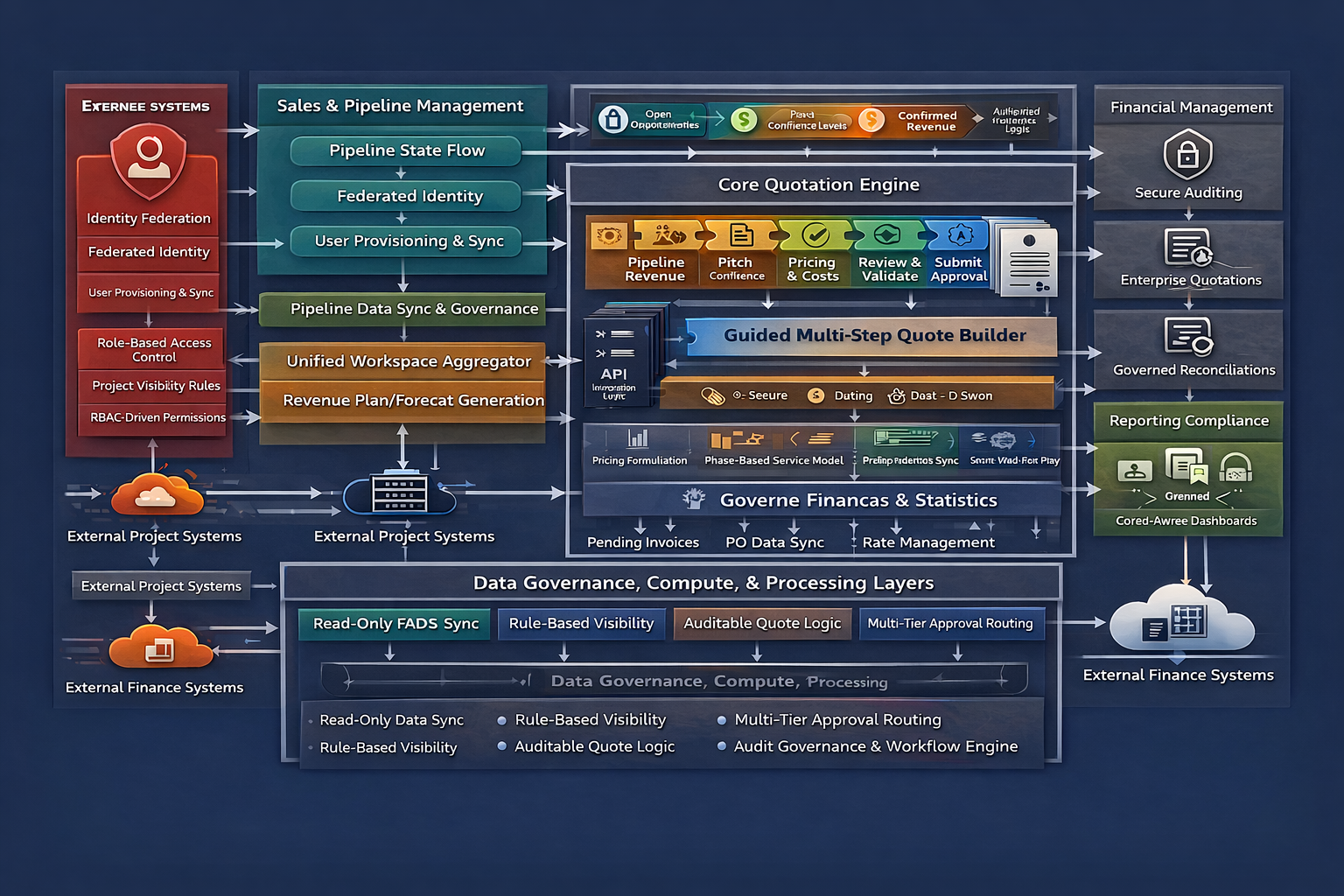
Back in late 2025, I took full ownership of architecting and building a custom Enterprise Quotation & Revenue Governance Platform for one of the world's top marketing agencies - Big Six caliber, operating at billion-dollar ad spend scale with strict internal controls. The timeline was aggressive: four months of continuous development under tight feedback loops and shifting business pressure. In that window we delivered multi-tier approval workflows, real-time revenue forecasting models, granular compliance-grade audit trails, dynamic campaign-based pricing logic, and fine-grained RBAC that let sales move fast while finance retained absolute control.
The first major failure surfaced during UAT on a low-RAM GCP instance, where concurrent quote edits triggered OutOfMemory crashes and event-loop stalls. The root cause was synchronous materialization of large intermediate financial datasets combined with ORM over-fetching under concurrency - the system was correct, but not resource-aware.
That failure forced a structural rethink. The computation pipeline was refactored to use streaming and chunked processing to flatten memory usage, heavy recalculations were moved to async queues, hot paths were aggressively indexed to eliminate N+1 patterns, and ORM queries were reduced by roughly 70% through targeted selects. RBAC enforcement, originally resolving permissions 10-15 times per request through DB joins, was redesigned using cached effective policy maps (LRU → Redis with versioned keys and event-driven invalidation), cutting permission checks from 15-40 ms to sub-millisecond latency without compromising revocation safety.
After refactoring, the same constrained infrastructure sustained full-load UAT concurrency without memory spikes while preserving financial integrity across revisions and audit trails. AI-assisted tooling accelerated scaffolding and testing during the compressed timeline, but the concurrency strategy, RBAC redesign, and trade-off decisions were architected and implemented directly.
I leaned on AI for scaffolding and tests to ship faster, but the concurrency model, RBAC hardening, and trade-offs were all born from those late-night flame charts after the crash. Sometimes the fastest way to harden a system is to watch it break under pressure - then redesign it deliberately.
Gallery
Note: This is a conceptual representation of an enterprise revenue governance platform. All branding, data, and identifiers have been modified for confidentiality purposes.
Project Screenshots